How to Calculate CBAM Embedded Emissions: What the Commission's August 2026 Guidance No. 3 Requires From Your Suppliers
On 14 August 2026 the European Commission published Guidance Document No. 3, which explains how producers outside the EU should calculate the emissions embedded in CBAM goods during the definitive period. The document is non-binding, but it is the clearest statement yet of what an accredited verifier will expect to see behind a supplier's numbers. For EU importers, that makes it a practical brief for your next supplier conversation.
Why this matters for importers
If your suppliers cannot show how they arrived at their emissions figures, you fall back on default values, which carry a markup that rises over time. Guidance No. 3 sets out the methods that produce numbers a verifier can sign off. Understanding them lets you ask suppliers the right questions instead of just sending a template and waiting.
Two families of methods
The guidance describes a calculation-based approach and a measurement-based approach.
Under the calculation-based approach, an operator monitors quantities of fuels and materials and applies emission factors, adjusting for oxidation and conversion losses. This is the standard method. A variant, the mass balance method, tracks the carbon content of all inputs and outputs across the installation.
Under the measurement-based approach, an operator uses continuous emissions measurement systems (CEMS) to measure emissions directly at installation level. The guidance points to this route in particular for non-CO2 gases such as nitrous oxide.
Where the system boundary sits
CBAM covers the emissions that would fall under the EU ETS if the production took place in Europe. In practice that means production processes and the upstream precursor materials that go into the good. Downstream use and end-of-life are outside the boundary.
Direct and indirect emissions
Direct emissions include combustion, process emissions and the production of heat consumed in manufacturing, wherever that heat originates. Indirect emissions, meaning those from electricity consumed in production, are relevant for cement, fertilisers and sintered ore. For other sectors, indirect emissions can still enter the calculation through precursors.
Precursors: the part importers underestimate
Complex goods that incorporate CBAM precursors must include the embedded emissions of those precursors. The guidance says operators must use either verified data from accredited verifiers or the default values. Where several suppliers or production years are involved, a weighted average applies. Actual precursor data is acceptable only if it comes from verified reports covering the relevant production period.
The consequence is a chain of custody for data. A fabricator that buys steel or aluminium inputs needs verified upstream reports, not just its own plant figures.
The monitoring plan
Operators are expected to maintain a documented monitoring plan describing production processes and system boundaries, data sources, calculation methodologies, and quality assurance procedures, including the cost-benefit reasoning behind monitoring investments. The guidance notes plans must be submitted in English. It also references a cost threshold for monitoring improvements, based on a EUR 80 carbon price reference and an annual limit of EUR 4,000.
Other changes to note
The guidance describes standardised functional units for the definitive period, for example clinker tonnes for cement and kilograms of nitrogen for fertilisers, along with mandatory aggregation rules for certain metal products. Production routes for identical goods are averaged rather than tracked separately, which improves comparability across installations but can surprise suppliers who run a low-carbon line next to a high-carbon one.
Checklist for your next supplier round
- Ask which method the supplier uses (standard calculation, mass balance or measurement) and request the monitoring plan in English.
- Confirm the system boundary matches the CBAM definition, including precursors.
- For complex goods, request verified reports for each precursor covering the same production period.
- Check that functional units match the ones in the guidance.
- Book verification early; see our guide to the CBAM verifier bottleneck.
- Keep the full data trail; see our record-keeping guide. The guidance summary we reviewed points to longer retention than under the transitional period, so confirm the exact period in the document itself.
FAQ
Is Guidance No. 3 legally binding? No. It explains the rules in accessible language, but the binding requirements sit in the CBAM Regulation and its implementing acts.
Can a supplier use measurement instead of calculation? Yes, the measurement-based approach is recognised, and is especially relevant for non-CO2 gases.
What happens if precursor data is not verified? Default values apply for that precursor, which is why upstream verification matters. See CBAM default values explained.
This article is general information, not legal advice. Check the guidance and the CBAM Regulation for your specific goods.
Related reading
The CBAM Verifier Bottleneck: Why Booking a Slot in Late 2026 Is the Real Compliance Decision
Verifier availability - not data quality - is the binding constraint on using actual embedded emissions for 2026 CBAM imports. Here's the arithmetic, the third-country gap, and what to do in Q4 2026.
The CSDDD Guidelines Are Where Compliance Is Actually Decided - Here's What to Build Before Q1 2027
The Commission's CSDDD implementation guidelines land in Q1 2027 - a year before transposition. They set the evidentiary standard, not the directive. Here's what is unresolved and what to build now.
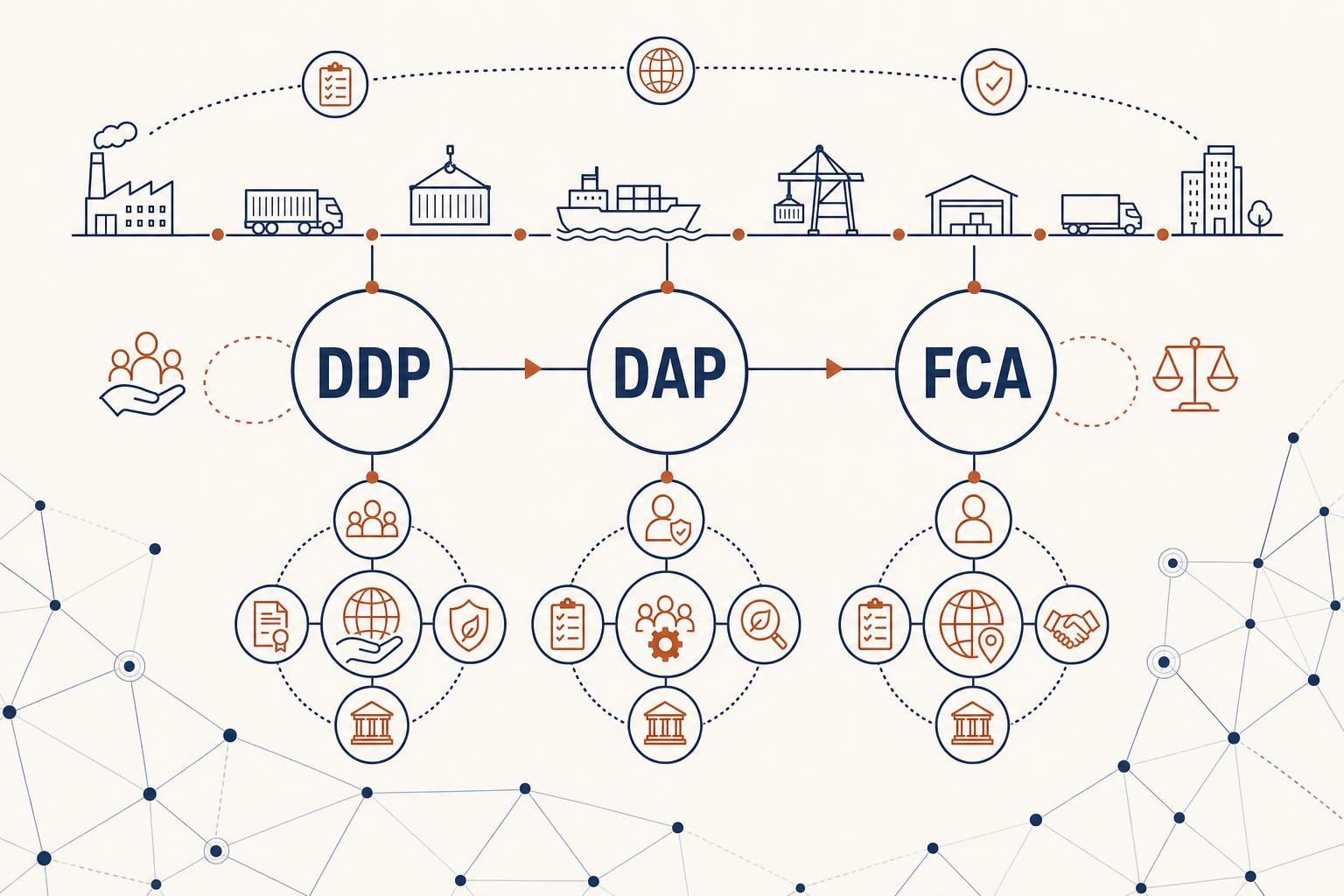
Three Letters, One Liability: How Your Incoterm Decides Who Pays CBAM
DDP, DAP, FCA - three letters in a contract determine who carries CBAM liability. A practical guide for procurement, trade compliance and legal teams on both sides of an EU import deal.