Three Letters, One Liability: How Your Incoterm Decides Who Pays CBAM
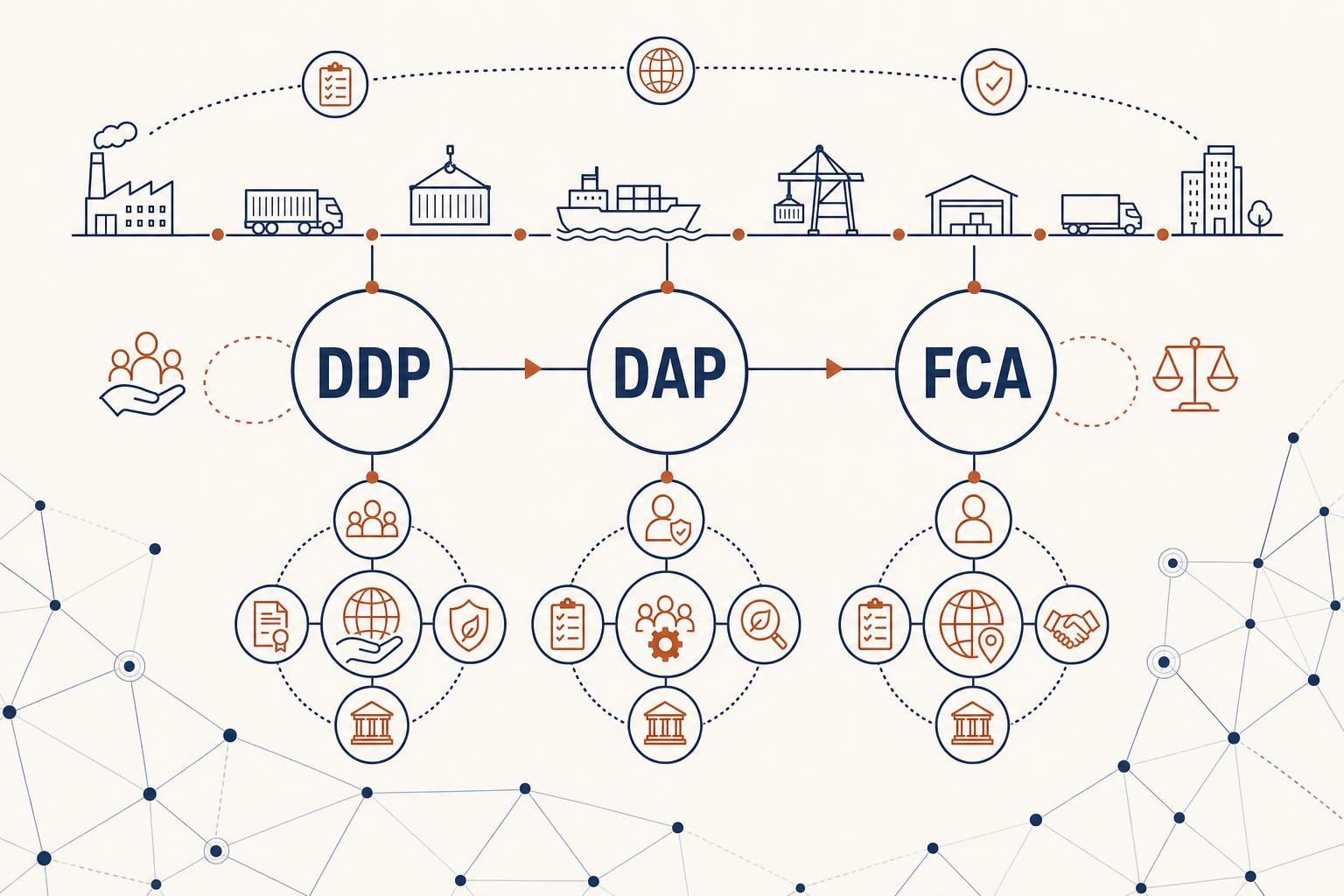
Two companies. Same steel coils. Same route from Türkiye to Rotterdam. One contract says DDP; the other says FCA. The goods are identical. The CBAM exposure is not.
Under FCA, the EU buyer clears the goods, holds authorised declarant status, and carries the certificate cost. Under DDP, the non-EU seller steps into the importer-of-record seat - and with it, every obligation that seat now carries under Regulation (EU) 2023/956. The seller may not have planned for that. The price list almost certainly did not include it. And the cash cost will not arrive until 2027, long after the invoice has been paid and the relationship has moved on.
This post is not a CBAM primer. It is a guide to who carries the cost between contracting parties, what the paperwork needs to say, and where the traps are.
How CBAM Liability Actually Attaches
CBAM liability is not allocated by the regulation in commercial terms. The regulation allocates it to a legal role: the authorised CBAM declarant. That is the entity which, under Article 4 of Regulation (EU) 2023/956, must hold declarant status before importing CBAM-covered goods, must file the annual declaration, and must surrender certificates against embedded emissions.
In order to import CBAM goods into the customs territory of the Union after 1 January 2026, importers must hold the status of an authorised CBAM declarant under Article 4 of Regulation (EU) 2023/956. Article 25 of the CBAM Regulation provides that customs authorities shall not allow the importation of goods by any person other than an authorised CBAM declarant.
The declarant is, in practice, whoever acts as importer of record on the EU customs declaration. That is what the Incoterm determines.
The Article 5(2) trap for non-EU sellers
There is a 50-tonne de minimis threshold in the Omnibus simplification (Regulation (EU) 2025/2083). The new 50-tonne per year threshold exempts importers with low CBAM import volumes from the obligation to register as a CBAM declarant - but this threshold applies only to importers established in the EU.
Non-EU sellers who assume small volumes mean no obligation are wrong. Importers not established in the EU always require an indirect representative who - regardless of the quantities declared - must be registered as an authorised CBAM declarant (Article 5(2) of Regulation (EU) 2023/956). The de minimis relief is structurally unavailable to them.
Indirect customs representatives require authorisation status as soon as they want to submit a customs declaration for the release of CBAM goods for free circulation in their own name but on behalf of an importer - regardless of whether the importers they represent have already exceeded the 50-tonne bulk threshold.
When an indirect customs representative holds declarant status, the consequences are significant. If the importer has appointed an indirect customs representative, that representative may obtain authorised CBAM declarant status in order to import CBAM-covered goods into the EU on behalf of the importer. In that case, the indirect customs representative assumes all obligations that would otherwise apply to the importer under the CBAM Regulation and is fully responsible for ensuring compliance with all CBAM requirements for any goods customs cleared on behalf of the importer.
Incoterm by Incoterm: Who Ends Up as Declarant
Incoterms do not themselves allocate CBAM cost. They determine who performs import clearance - and the CBAM obligation follows that role. The table below maps the five terms most relevant to EU imports of CBAM goods.
| Incoterm | Who clears EU customs? | Likely CBAM declarant | Key CBAM risk |
|---|---|---|---|
| DDP | Seller (or seller's agent) | Non-EU seller / indirect rep | Seller becomes declarant by default; must appoint authorised indirect rep regardless of volume |
| DAP | Buyer | EU buyer | Buyer carries cost but may not have priced it; seller must supply emissions data |
| FCA | Buyer | EU buyer | Clean split — buyer is declarant; data obligation on seller must be contractually secured |
| EXW | Buyer | EU buyer | Buyer controls clearance but seller has least contractual obligation to provide data |
| CIF / CIP | Buyer | EU buyer | Seller arranges freight/insurance but buyer clears; cost sits with buyer, data obligation with seller |
DDP is the outlier. DDP puts most obligations on the seller - they carry all the costs and risks of transport, insurance, and customs clearance. It is the only Incoterm that lists the seller as the importer of record at destination. DDP hands the seller responsibility for import formalities in the destination country. Under the CBAM regime, the party acting as importer of record is the party that needs authorised CBAM declarant status, and the party that ultimately has to surrender certificates against the embedded emissions of what it has shipped.
DAP stops short of import clearance. Under DAP, the seller covers the costs involved in main carriage but is not responsible for customs clearance. The buyer clears the goods and is the declarant. The seller's obligation is to supply compliant emissions data - which must be written into the contract.
FCA and EXW both place the buyer in the customs seat. The practical difference for CBAM is the data flow: under FCA the seller has already handled export clearance and has a stronger operational relationship with the logistics chain, making data collection somewhat easier to contractualise. Under EXW the seller's involvement ends at the factory gate, and the data obligation must be explicit or it will be ignored.
CIF and CIP are sea/multimodal terms where the seller arranges and pays for freight and insurance to the named destination, but the buyer clears the goods on arrival. The buyer is the declarant; the seller's CBAM obligation is purely informational.
The Three Commercial Risks
Risk 1: The seller who becomes declarant by accident under DDP
A non-EU manufacturer quotes DDP to make life simple for an EU customer - one clean landed price, no customs headache for the buyer. Even where a broker provides a customs service, they are still acting on behalf of the UK company where the exporter is the importer of record under DDP terms. Getting this wrong or simply not checking it is how exporters end up as the CBAM declarant without having planned to be.
The seller now needs an authorised indirect customs representative in the EU - mandatory under Article 5(2) regardless of volume - and carries the certificate surrender obligation for goods it has already sold and invoiced. The CBAM cost was not in the DDP price. There is no mechanism to recover it from the buyer after the fact unless the contract says so.
Risk 2: The buyer who priced goods without the certificate cost
Under DAP, FCA or EXW, the EU buyer is the declarant and carries the cost. If the purchase order was placed before the buyer modelled CBAM exposure - or if the buyer assumed the seller would absorb it - the certificate cost lands as an unbudgeted liability.
The Q1 2026 CBAM certificate price was set at €75.36 per tonne of CO₂e, with Q2 2026 at €75.28. For a mid-market steel importer bringing in 5,000 tonnes of blast-furnace slab at roughly 2.0 tCO₂/tonne, that is a gross certificate exposure of approximately €750,000 for the year - before the CBAM factor adjustment (2.5% in 2026) and any deduction for carbon price already paid in the country of origin. The factor ramps to 100% by 2034, so the same calculation at full phase-in is forty times larger in factor terms.
EU buyers are already inserting CBAM-related clauses into contracts, requiring emissions data disclosure and reserving the right to renegotiate prices or terminate contracts if data is not provided.
Risk 3: The timing and cash-flow gap
This is the risk that catches both sides off guard. Goods imported throughout 2026 generate a certificate obligation priced at the quarterly EU ETS average for the quarter of importation. But the cash does not move until 2027.
CBAM certificate sales open on 1 February 2027, and the first annual declaration and surrender deadline - covering all 2026 imports - falls on 30 September 2027. The start of CBAM certificate sales was postponed from 1 January 2026 to 1 February 2027. Declarants will acquire certificates in 2027 for embedded emissions from 2026 imports, with full compliance obligations applicable retroactively.
The goods can therefore be imported, transformed, invoiced to a customer, and converted into revenue before the cash outflow for the related CBAM certificates begins. That sequence changes the accounting and control problem. The absence of a certificate invoice in 2026 does not justify ignoring the cost until 2027. Finance must build accrual and forecasting logic around customs and emissions data, not the later payment event - otherwise, product margins can look intact while the business carries an unallocated future obligation.
A contract signed and performed in 2026 generates a cash cost 9 to 21 months later, often after the commercial relationship or the price list has moved on. Any pass-through mechanism that is not written into the original contract will be renegotiated under commercial pressure, or not recovered at all.
Drafting the CBAM Cost Clause
A workable CBAM clause is not a single sentence. It is a cluster of interlocking provisions. Here is what each one needs to do.
Do not rely on a generic reference to 'CBAM goods'. List the specific Combined Nomenclature (CN) codes covered by the contract. This matters because the CBAM factor, default values, and embedded emissions methodology differ by product category. A clause that says 'steel products' is ambiguous; a clause that lists CN 7208, 7209, 7210 is not.
State explicitly which party is the authorised CBAM declarant for each shipment. If the seller ships DDP and will use an indirect customs representative, name the representative or specify the selection criteria and confirm that the representative holds authorised declarant status under Article 5(2) of Regulation (EU) 2023/956. Silence here means the obligation falls on whoever the customs declaration names — which may not be who the commercial parties intended.
The declarant's certificate cost depends entirely on the embedded emissions figure used. If the supplier fails to provide installation-level data calculated under the EU Monitoring and Reporting Regulation (MRR) methodology, the declarant falls back on Commission default values — which carry a mark-up (10% in 2026, rising to 30% by 2028 for most sectors). The clause must require the supplier to deliver compliant emissions data by a specified date before the annual declaration deadline, specify the verification standard, and allocate the cost of the mark-up to the supplier if data is not provided on time.
Because the certificate price is not known at contracting time (it tracks the EU ETS quarterly average for 2026, then weekly from 2027), a fixed-adder clause will either over- or under-recover. The market practice emerging in 2026 is an EUA-indexed surcharge: the buyer pays the seller (or the seller credits the buyer) an amount equal to the number of certificates attributable to the shipment multiplied by the applicable quarterly or weekly ETS average price, adjusted for the CBAM factor in force at the time of importation. Cap provisions — a ceiling on the pass-through — are common in longer-term supply agreements where the buyer cannot absorb open-ended ETS exposure.
Regulation (EU) 2023/956 allows a deduction for carbon prices already paid in the country of origin. The clause must require the supplier to document any such payment — the applicable carbon pricing scheme, the rate paid, and the calculation methodology — and must specify what happens if the documentation is not provided (the deduction is forfeited and the full certificate cost applies). This is particularly relevant for goods from the UK, Canada, and jurisdictions with functioning carbon markets.
The declarant must retain CBAM records for at least five years. Where the supplier holds the underlying production data, the contract must require the supplier to retain and make available equivalent records for the same period, and to cooperate with any verification audit. A clause that gives the declarant audit rights over the supplier's emissions records is standard in well-drafted agreements.
State explicitly that if the supplier fails to provide compliant emissions data by the contractual deadline, the declarant will use Commission default values, and the resulting mark-up cost — plus any penalty exposure attributable to the data gap — will be charged back to the supplier. Without this provision, the buyer carries the mark-up cost that the seller's non-compliance created.
What Incoterms do not do. Incoterms 2020 determine who performs customs clearance and bears transport risk. They do not allocate CBAM cost between the parties. A contract that says DDP but is silent on CBAM leaves the seller as declarant with no contractual right to recover the certificate cost from the buyer. A contract that says FCA but is silent on emissions data leaves the buyer as declarant with no contractual right to compliant data from the seller. The Incoterm sets the stage; the CBAM clause determines who pays.
Renegotiating Existing Contracts That Run Past 2026
Many supply agreements were signed before the definitive regime was live. If yours runs into 2027 or beyond, the following checklist identifies the minimum interventions needed.
Step 1 - Identify the declarant. Pull the customs declarations for your last four shipments. Which EORI number appears as importer of record? That entity is currently carrying the CBAM obligation whether or not the contract says so.
Step 2 - Check the Incoterm against the intended allocation. If the Incoterm and the intended cost allocation are misaligned, the contract needs an amendment - either changing the Incoterm or adding an explicit CBAM cost-allocation clause that overrides the default customs role.
Step 3 - Audit the emissions data pipeline. Is the supplier already providing MRR-aligned installation-level data? If not, what is the contractual obligation to do so, and what is the consequence of non-delivery? If there is no obligation, add one now. The 30 September 2027 declaration deadline is fixed.
Step 4 - Model the accrual. Even if certificates are not purchased until February 2027, the liability accrues from the date of each import. Finance needs to book a provision based on the quarterly ETS price and the estimated embedded emissions of each shipment. Waiting for the certificate invoice is not an acceptable accounting approach.
Step 5 - Agree the pass-through mechanism before the declaration deadline. Once the annual declaration is filed and the certificate cost is known, the commercial leverage to negotiate a pass-through evaporates. The time to agree the mechanism is now, not in September 2027.
Use the Decision Tool: Who Is Your CBAM Declarant?
The widget below walks through the key questions - Incoterm, establishment, volume, and indirect representative status - and outputs which party carries the declarant obligation and what contractual provisions are missing.
The Bottom Line
CBAM liability is not a customs technicality that sits outside the commercial relationship. It is a financial obligation that attaches to a legal role - the authorised declarant - and that role is determined, in practice, by three letters on the commercial invoice.
The regulation is settled on this point. What is not settled is the commercial allocation between contracting parties, because the regulation does not touch that. That allocation is a matter of contract, and contracts written before 2026 - or written in 2026 without explicit CBAM provisions - are almost certainly silent on the questions that matter most: who is the declarant, who provides the data, what happens when the data does not arrive, and how does the certificate cost flow between buyer and seller when it crystallises in 2027.
Procurement, trade compliance and legal teams on both sides of an EU import contract have a narrow window to fix this before the first annual declaration deadline of 30 September 2027. The commercial leverage to negotiate a fair allocation is highest now, while the cost is still an estimate. After the declaration is filed, it is a known number - and the party holding the liability will be negotiating from a much weaker position.
Does the Incoterm legally determine who pays CBAM?
No. Incoterms determine who performs import customs clearance — and the CBAM obligation follows whoever acts as importer of record on the customs declaration. But Incoterms do not allocate the cost of CBAM between buyer and seller. That allocation is a matter of contract. A DDP seller who is the declarant has no automatic right to recover the certificate cost from the buyer unless the contract says so.
Can a non-EU seller avoid being the CBAM declarant under DDP?
Yes, but only by restructuring the commercial arrangement. Options include: (a) switching the Incoterm to DAP or FCA so the EU buyer clears the goods; (b) appointing an EU-established indirect customs representative who holds authorised CBAM declarant status and agrees to assume the CBAM obligations — though this requires the representative to be willing and authorised, and the cost still needs to be allocated contractually.
Does the 50-tonne de minimis threshold help a non-EU seller shipping DDP?
No. Under Article 5(2) of Regulation (EU) 2023/956, importers not established in the EU always require an indirect customs representative who must hold authorised CBAM declarant status regardless of the volume declared. The 50-tonne de minimis is available only to EU-established importers.
When does the CBAM certificate cost actually become a cash outflow?
Certificate sales open on 1 February 2027. The first annual declaration and surrender, covering all 2026 imports, is due by 30 September 2027. Goods imported in January 2026 therefore generate a cash cost up to 21 months later. The liability accrues from the date of importation, however, and should be provisioned in the accounts from that date.
What happens if the supplier does not provide emissions data?
The declarant falls back on Commission default values, which carry a mark-up (10% in 2026, rising to 30% by 2028 for most sectors except fertilisers). That mark-up is the declarant's cost unless the contract explicitly allocates it to the supplier who failed to provide data. Without a data-failure consequence clause, the buyer absorbs the cost of the seller's non-compliance.
Can a carbon price already paid in the country of origin be deducted?
Yes. Regulation (EU) 2023/956 allows a deduction for carbon prices effectively paid in the country of production. The declarant must document the applicable scheme, the rate paid, and the calculation. If the supplier does not provide this documentation, the deduction is forfeited. The contract should require the supplier to deliver this documentation as part of the emissions data package.
Related reading
The CBAM Verifier Bottleneck: Why Booking a Slot in Late 2026 Is the Real Compliance Decision
Verifier availability - not data quality - is the binding constraint on using actual embedded emissions for 2026 CBAM imports. Here's the arithmetic, the third-country gap, and what to do in Q4 2026.
The CSDDD Guidelines Are Where Compliance Is Actually Decided - Here's What to Build Before Q1 2027
The Commission's CSDDD implementation guidelines land in Q1 2027 - a year before transposition. They set the evidentiary standard, not the directive. Here's what is unresolved and what to build now.
Asking Suppliers for Data Under CSDDD: What the Omnibus Limits on Information Requests Mean in Practice
After Omnibus I, CSDDD companies can no longer send every supplier the same long questionnaire. Here is what the necessity and proportionality limits mean, and how to redesign your supplier data requests.